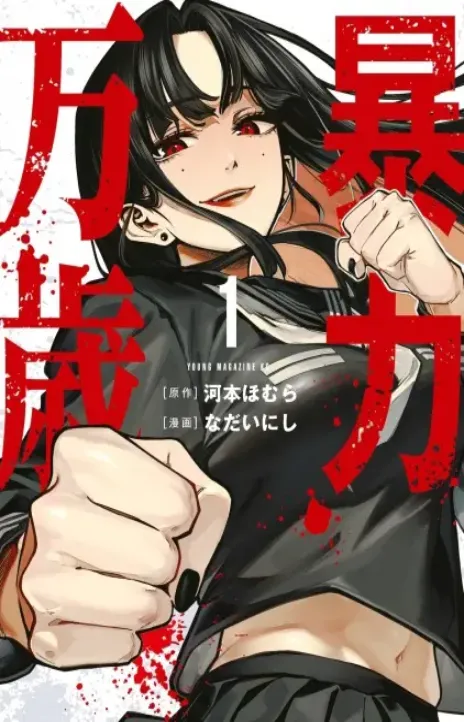
Bouryoku Banzai
A back-alley gutter still slick with the blood of the delinquents who cornered him. Masamichi Akita presses a palm to the brickwork, catching his breath, watching a girl with ink-black hair dismantle three bodies with the blank efficiency of broken glass. No flourish, no hesitation. His motto is "live smart" — calculate the odds, avoid the punch, survive another day. So when Setsuna Rikudou turns to leave without a word, he calculates again, slots admiration alongside self-interest, and asks the only question that makes tactical sense: "Teach me how to fight."
Her answer arrives as a fist. She pivots, bares teeth that are not metaphor, and sends him crashing into the wall he was just leaning on. "The only rule in this world is violence." Not philosophy. Diagnosis. She is not a delinquent queen or a street-fighting prodigy — she is a supremacist of force itself, a woman who has stripped every social contract down to the raw nerve of dominance. Akita, the boy who built a life on ducking and weaving through the margins, now stands inside a threshold he cannot unsee. The classroom, the hallways, the streets he walks home — all of it was always violence wearing softer names. She simply drew the curtain. The question is no longer whether he can learn to throw a punch. The question is whether a person who steps into her world ever steps back out human.
Also known as: Bōryoku Banzai, Violence Hurrah, Violence Hurray, 暴力万歳.